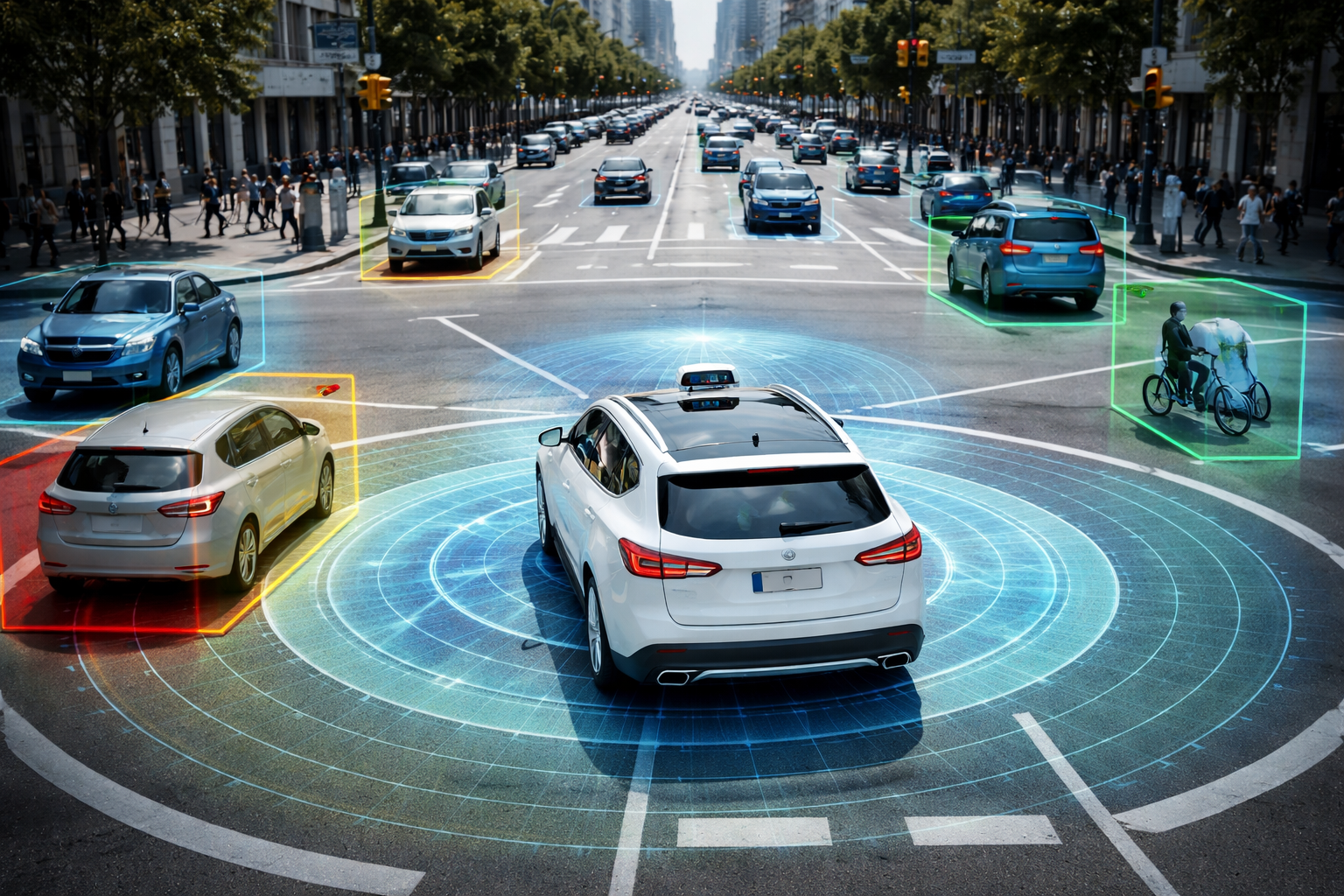
Artificial intelligence is rapidly transforming the automotive industry. Advanced driver-assistance systems such as Tesla’s Full Self-Driving (FSD) and General Motors’ Super Cruise promise safer roads, reduced human error, and greater convenience. However, as these systems become more capable, a pressing legal and ethical question emerges: who is responsible when an AI-assisted vehicle causes an accident?
The answer is far from simple. Current U.S. regulations still assume a human driver is ultimately in control. Yet modern AI systems blur the line between driver assistance and autonomous operation. As a result, responsibility in crash scenarios often falls into a legal gray area.
The Current Legal Framework
In the United States, liability for car accidents traditionally falls on the driver. Traffic laws are written with the assumption that a human is making decisions behind the wheel. Even when advanced driver-assistance systems are engaged, the driver is legally expected to monitor the vehicle and intervene when necessary.
Manufacturers, including Tesla, emphasize that their systems require active driver supervision. In owner manuals and on-screen prompts, companies state that the driver must remain attentive and ready to take control at all times. This positioning protects automakers from full liability because the technology is marketed as assistance—not full autonomy.
However, the practical reality is more complicated. As systems become more sophisticated, drivers may overestimate their capabilities and rely on them more than intended. When accidents occur under these conditions, determining fault becomes increasingly difficult.
The Manufacturer’s Responsibility
Product liability law may hold manufacturers accountable if a vehicle’s technology is proven defective or unreasonably dangerous. If an AI system fails to detect an obstacle it reasonably should have identified, or behaves unpredictably, a manufacturer could face legal consequences.
Investigations by federal safety agencies into crashes involving driver-assistance systems demonstrate growing scrutiny. These investigations examine whether software design, sensor limitations, or system communication failures contributed to accidents.
The challenge lies in defining what constitutes a “defect” in artificial intelligence. AI systems learn from vast datasets and make probabilistic decisions. Unlike traditional mechanical failures, AI errors may stem from rare driving scenarios that were not sufficiently represented during training. This makes accountability more complex than in conventional vehicle defects.
The Driver’s Responsibility
Even as automation increases, drivers remain legally responsible in most states. Courts often evaluate whether the driver acted reasonably under the circumstances. If the driver ignored warnings, failed to monitor the roadway, or misused the system, liability may remain primarily with them.
However, this expectation may conflict with human psychology. Research in human factors engineering shows that people tend to trust automated systems once they demonstrate consistent performance. Over time, drivers may become less vigilant, assuming the system will handle unexpected situations. This phenomenon, known as automation complacency, complicates arguments that drivers are solely at fault.
Regulatory Gaps and Policy Challenges
One of the central issues is that federal regulations have not fully adapted to rapid advancements in AI driving systems. Currently, there is no unified national standard that clearly defines levels of responsibility in semi-autonomous crashes.
Some experts argue that clearer classification systems should determine liability thresholds. Others propose shared responsibility models, where both the driver and manufacturer may bear partial fault depending on system performance and driver behavior.
As AI systems approach higher levels of autonomy, legal frameworks may need to shift from driver-centered liability toward product-centered liability. This transition would represent a fundamental change in how transportation law operates.
Ethical Implications
Beyond legality, there are ethical considerations. If a company promotes a system as highly capable while knowing drivers may misunderstand its limitations, ethical responsibility increases—even if legal liability does not. Transparency in marketing, system naming, and user education plays a significant role in public trust.
Additionally, if AI systems statistically reduce overall accidents compared to human drivers, policymakers must balance isolated failures against broader societal safety gains. This raises difficult questions about acceptable risk and technological progress.
Looking Forward
As artificial intelligence continues to evolve in the automotive sector, responsibility will likely become more distributed. Clearer federal standards, improved driver monitoring systems, and updated policy frameworks will be essential.
Artificial intelligence may be redefining transportation, but accountability must evolve alongside innovation. Without clear standards, the legal uncertainty surrounding AI driving systems could slow adoption and undermine public trust.
← Return to Articles